
Every screen after sunset tells your brain it's noon
The signal band
Your clock listens to a narrow band of light.
The receptors that set your body clock respond most strongly to short wavelengths — roughly the 400–500 nm range that white screens and cool LEDs emit heavily. Evening exposure in that band suppresses your body's own wind-down signal. Filter the band, and the signal quiets.
Hatched region: the short-wavelength band the VEYRO lenses are built to filter. The rest of the spectrum passes — that's why you can still see, work and read.
Measured, not implied
What each lens actually blocks
Clear "blue light" lenses typically filter only 10–25% of the range that matters. People who bought them felt nothing — and they were right to feel cheated. So here are ours, stated exactly — and the clear-lens baseline that explains why you may have felt nothing before.
The tint is the mechanism: a lens that really blocks blue light cannot be colourless. If it looks clear, it isn't doing this. The tint isn't styling.
Blue light blocked, by lens type
Share of the 400–500 nm band filtered
Visible light passed
How much of the room you still see
The Day lens keeps screens fully usable. The Night lens dims the room on purpose — dimming is part of the wind-down, not a side effect.
Let's see Why the tint matters
The blue light your screens actually put out
Phones, laptops and LED lighting spike hard around 455nm. In the daytime that spike adds to eye strain. After sunset it tells your brain it's still noon — holding back the wind-down your body is trying to start. The tint is what blocks it. Clear lenses don't.
Two windows, two jobs
Same Mechanism, Different Hours.
Daytime · comfort
The Day lens is about glare, not your clock.
During the day, blue light isn't the enemy — morning light usefully sets your rhythm. What wears you down is hours of intense, high-glare screen output. The Day lens takes the edge off that: 96.18% of the blue band out, 40–50% of visible light through, so the afternoon costs less.
We say "comfort" deliberately. The independent evidence that filtering daytime blue light treats eye strain is mixed, and we won't claim what the data doesn't hold. What the lens changes is how harsh the hours feel.
Evening · recovery
The Night lens is about the time signal.
After sunset, the same band becomes a false "it's noon" signal that suppresses your body's own melatonin wind-down. The Night lens blocks 98.7% of it and dims the room to 28–38% — so the evening stops arguing with your body clock.
Everything turns red with it on. That's not a defect; that's what a 98.7% block looks like from the inside.
Let Us Explain
Light Routine Matters
Not all blue light should be treated the same. That’s why VEYRO is built as a day-to-night system
Morning
No lens. On purpose
Morning blue light is useful — it wakes you up and boosts energy. Don't filter it.
Afternoon
Day Lens on
When screen time starts to add up: 96.18% of blue light out, screens still readable.
Sunset
Swap to the Night Lens
98.7% blocked until the screens go off. Screens stop arguing with your body clock.
Lights out
Mask on, list written
Clear your head with a Planner. The Sleep Mask closes the last gap — total darkness.
Day Lens for comfort · Night Lens for recovery
The full evening, covered
Three Tools. One Goal.

The light layer
VEYRO Day & Night Blue Light Blockers Set
Two lenses, one for each half of the day. The core of the system.
The concealment layer
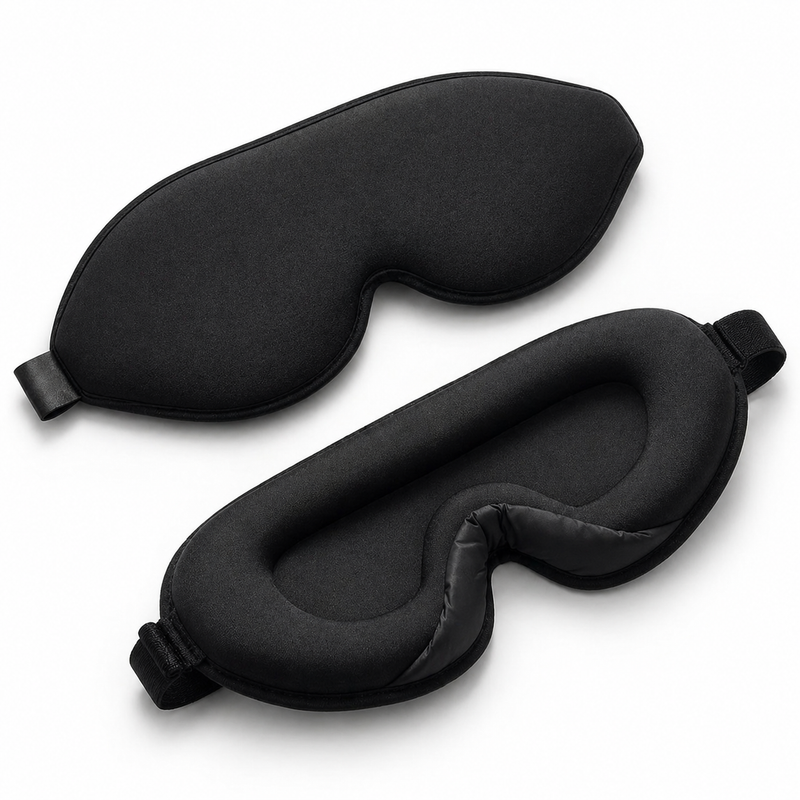
VEYRO Sleep Mask
The Lenses filter what's in front of your eyes. The Mask blocks out light completely.

Paper for a racing mind
VEYRO Everyday Planner
Put your thoughts and tomorrow's list on paper so it stops running laps at midnight.